Showing posts with label Funny Poultry. Show all posts

Tuesday, January 25, 2011

Funny Poultry 1

Description
Poultry is a category of domesticated birds kept by humans for the purpose of collecting their eggs, or killing for their meat and/or feathers. These most typically are members of the superorder Galloanserae (fowl), especially the order Galliformes (which includes chickens, quails and turkeys) and the family Anatidae (in order Anseriformes), commonly known as "waterfowl" (e.g. domestic ducks and domestic geese). Poultry also includes other birds which are killed for their meat, such as pigeons or doves or birds considered to be game, like pheasants. Poultry comes from the French/Norman word, poule, itself derived from the Latin word Pullus, which means small animal.

A bird wants to drink.


Two pigeons are having date.


They are sharing their necks.


Two birds have a nice time.


Go away, or we will fall then.

Monday, January 24, 2011

Funny Poultry 2

Birds (class Aves) are feathered, winged, bipedal, endothermic (warm-blooded), egg-laying, vertebrate animals. There are around 10,000 living species, making them the most speciose class of tetrapod vertebrates. They inhabit ecosystems across the globe, from the Arctic to the Antarctic. Extant birds range in size from the 5 cm (2 in) Bee Hummingbird to the 2.75 m (9 ft) Ostrich. The fossil record indicates that birds evolved from theropod dinosaurs during the Jurassic period, around 150–200 Ma (million years ago), and the earliest known bird is the Late Jurassic Archaeopteryx, c 150–145 Ma. Most paleontologists regard birds as the only clade of dinosaurs to have survived the Cretaceous–Tertiary extinction event approximately 65.5 Ma.

A beautiful owl is yarning.


Modern birds are characterised by feathers, a beak with no teeth, the laying of hard-shelled eggs, a high metabolic rate, a four-chambered heart, and a lightweight but strong skeleton. All living species of birds have wings - the now extinct flightless Moa of New Zealand were the only exceptions. Wings are evolved forelimbs, and most bird species can fly, with some exceptions including ratites, penguins, and a number of diverse endemic island species. Birds also have unique digestive and respiratory systems that are highly adapted for flight. Some birds, especially corvids and parrots, are among the most intelligent animal species; a number of bird species have been observed manufacturing and using tools, and many social species exhibit cultural transmission of knowledge across generations.

Two beautiful birds are fighting.


Many species undertake long distance annual migrations, and many more perform shorter irregular movements. Birds are social; they communicate using visual signals and through calls and songs, and participate in social behaviours including cooperative breeding and hunting, flocking, and mobbing of predators. The vast majority of bird species are socially monogamous, usually for one breeding season at a time, sometimes for years, but rarely for life. Other species have breeding systems that are polygynous ("many females") or, rarely, polyandrous ("many males"). Eggs are usually laid in a nest and incubated by the parents. Most birds have an extended period of parental care after hatching.

It's Ostrich racing.


Many species are of economic importance, mostly as sources of food acquired through hunting or farming. Some species, particularly songbirds and parrots, are popular as pets. Other uses include the harvesting of guano (droppings) for use as a fertiliser. Birds figure prominently in all aspects of human culture from religion to poetry to popular music. About 120–130 species have become extinct as a result of human activity since the 17th century, and hundreds more before then. Currently about 1,200 species of birds are threatened with extinction by human activities, though efforts are underway to protect them.

I'll catch you, fish.


Penguins are in action.

Sunday, January 23, 2011

Funny Poultry 3

Evolution and Taxonomy
The first classification of birds was developed by Francis Willughby and John Ray in their 1676 volume Ornithologiae. Carolus Linnaeus modified that work in 1758 to devise the taxonomic classification system currently in use. Birds are categorised as the biological class Aves in Linnaean taxonomy. Phylogenetic taxonomy places Aves in the dinosaur clade Theropoda. Aves and a sister group, the clade Crocodilia, contain the only living representatives of the reptile clade Archosauria. Phylogenetically, Aves is commonly defined as all descendants of the most recent common ancestor of modern birds and Archaeopteryx lithographica.

Share the food, please.


Archaeopteryx, from the Tithonian stage of the Late Jurassic (some 150–145 million years ago), is the earliest known bird under this definition. Others, including Jacques Gauthier and adherents of the Phylocode system, have defined Aves to include only the modern bird groups, the crown group. This has been done by excluding most groups known only from fossils, and assigning them, instead, to the Avialae in part to avoid the uncertainties about the placement of Archaeopteryx in relation to animals traditionally thought of as theropod dinosaurs.

He is a real bird lover. Hi, don't peck my lips.

All modern birds lie within the subclass Neornithes, which has two subdivisions: the Palaeognathae, containing birds that are flightless (like ostriches) or weak fliers, and the wildly diverse Neognathae, containing all other birds. These two subdivisions are often given the rank of superorder,[7] although Livezey and Zusi assigned them "cohort" rank. Depending on the taxonomic viewpoint, the number of known living bird species varies anywhere from 9,800 to 10,050.

Am I a real bookworm?


Two penguins are walking hand-in-hand.

Saturday, January 22, 2011

Funny Poultry 4

Description
Duck is the common name for a number of species in the Anatidae family of birds. The ducks are divided between several subfamilies in the Anatidae family; they do not represent a monophyletic group but a form taxon, since swans and geese are not considered ducks. Ducks are mostly aquatic birds, mostly smaller than the swans and geese, and may be found in both fresh water and sea water.

Ducks are sometimes confused with several types of unrelated water birds with similar forms, such as loons or divers, grebes, gallinules, and coots.

Just stay still, kids, or you will fall.


Swans, genus Cygnus, are birds of the family Anatidae, which also includes geese and ducks. Swans are grouped with the closely related geese in the subfamily Anserinae where they form the tribe Cygnini. Sometimes, they are considered a distinct subfamily, Cygninae. There are six to seven species of swan in the genus Cygnus; in addition there is another species known as the Coscoroba Swan, although this species is no longer considered related to the true swans. Swans usually mate for life, though 'divorce' does sometimes occur, particularly following nesting failure. The number of eggs in each clutch ranges from three to eight.

Dating Time


Help! Help! Help! I am not guilty.


Marching Time


The chicken (Gallus gallus domesticus) is a domesticated fowl, a subspecies of the Red Junglefowl. As one of the most common and widespread domestic animals, and with a population of more than 24 billion in 2003, there are more chickens in the world than any other species of bird. Humans keep chickens primarily as a source of food, consuming both their meat and their eggs.

Recent evidence suggests that domestication of the chicken was already under way in Thailand, Vietnam and the South East Asian jungles over 10,000 years ago, and spread into neighboring regions to the east such as China, and towards the west in India where it was conventionally thought to have been domesticated. From India the domesticated fowl made its way to the Persianized kingdom of Lydia in western Asia Minor, and domestic fowl were imported to Greece by the fifth century BC. Fowl had been known in Egypt since the 18th Dynasty, with the "bird that lays every day" having come to Egypt from the land between Syria and Shinar, Babylonia, according to the annals of Tutmose III.

From the deepest of my heart I solute you.

Friday, January 21, 2011

Funny Poultry 5

Containing all modern birds, the subclass Neornithes is, due to the discovery of Vegavis, now known to have evolved into some basic lineages by the end of the Cretaceous and is split into two superorders, the Palaeognathae and Neognathae. The paleognaths include the tinamous of Central and South America and the ratites. The basal divergence from the remaining Neognathes was that of the Galloanserae, the superorder containing the Anseriformes (ducks, geese, swans and screamers) and the Galliformes (the pheasants, grouse, and their allies, together with the mound builders and the guans and their allies). The dates for the splits are much debated by scientists. It is agreed that the Neornithes evolved in the Cretaceous, and that the split between the Galloanseri from other Neognathes occurred before the K–T extinction event, but there are different opinions about whether the radiation of the remaining Neognathes occurred before or after the extinction of the other dinosaurs. This disagreement is in part caused by a divergence in the evidence; molecular dating suggests a Cretaceous radiation, while fossil evidence supports a Tertiary radiation. Attempts to reconcile the molecular and fossil evidence have proved controversial.

May I borrow your hat, please!


The classification of birds is a contentious issue. Sibley and Ahlquist's Phylogeny and Classification of Birds (1990) is a landmark work on the classification of birds, although it is frequently debated and constantly revised. Most evidence seems to suggest that the assignment of orders is accurate, but scientists disagree about the relationships between the orders themselves; evidence from modern bird anatomy, fossils and DNA have all been brought to bear on the problem, but no strong consensus has emerged. More recently, new fossil and molecular evidence is providing an increasingly clear picture of the evolution of modern bird orders.

I have something wrong with my neck.


How smooth your feather is!


You look ugly when you are mad.


Ducks exploit a variety of food sources such as grasses, aquatic plants, fish, insects, small amphibians, worms, and small molluscs.

Diving ducks and sea ducks forage deep underwater. To be able to submerge more easily, the diving ducks are heavier than dabbling ducks, and therefore have more difficulty taking off to fly.

Dabbling ducks feed on the surface of water or on land, or as deep as they can reach by up-ending without completely submerging. Along the edge of the beak there is a comb-like structure called a pecten. This strains the water squirting from the side of the beak and traps any food. The pecten is also used to preen feathers.

A few specialized species such as the mergansers are adapted to catch and swallow large fish.

The others have the characteristic wide flat beak designed for dredging-type jobs such as pulling up waterweed, pulling worms and small molluscs out of mud, searching for insect larvae, and bulk jobs such as dredging out, holding, turning headfirst, and swallowing a squirming frog. To avoid injury when digging into sediment it has no cere. but the nostrils come out through hard horn.

Excuse me, Sir! Give us time to cross this road.

Thursday, January 20, 2011

Funny Poultry 6

Birds live and breed in most terrestrial habitats and on all seven continents, reaching their southern extreme in the Snow Petrel's breeding colonies up to 440 kilometres (270 mi) inland in Antarctica. The highest bird diversity occurs in tropical regions. It was earlier thought that this high diversity was the result of higher speciation rates in the tropics, however recent studies found higher speciation rates in the high latitudes that were offset by greater extinction rates than in the tropics. Several families of birds have adapted to life both on the world's oceans and in them, with some seabird species coming ashore only to breed and some penguins have been recorded diving up to 300 metres (980 ft).

Go away from my habitat or I will peck you.

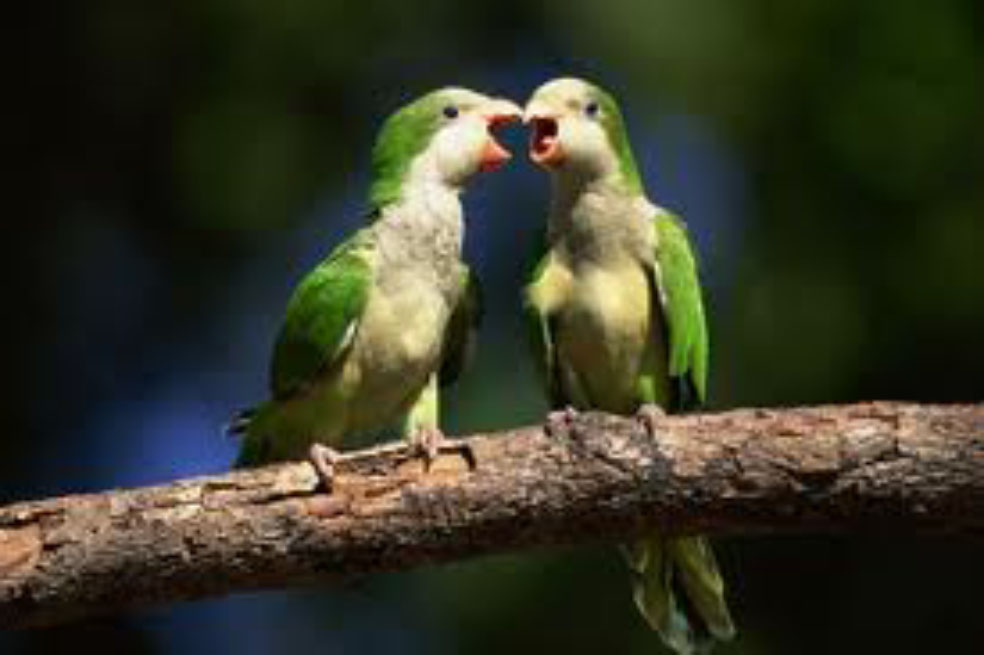
Many bird species have established breeding populations in areas to which they have been introduced by humans. Some of these introductions have been deliberate; the Ring-necked Pheasant, for example, has been introduced around the world as a game bird. Others have been accidental, such as the establishment of wild Monk Parakeets in several North American cities after their escape from captivity. Some species, including Cattle Egret, Yellow-headed Caracara and Galah, have spread naturally far beyond their original ranges as agricultural practices created suitable new habitat.

Actually, I just want to drink, bu I also take a bath in this situation.


Come on, friends. Let's continue our journey.


Hi, are you deaf? Go away from this place!

Funny Poultry 7: It's sleepery here.

It's sleepery here.